
English short stories for learners: Reading, Listening, Understanding
Start with CEFR-graded English short stories that offer vocabulary help and an audio version. That's the fastest route to real progress. Why? Because short, self-contained texts do exactly what Edgar Allan Poe described as the "Unified Effect": they create a focused impact in a single reading session and keep motivation high. For learners this means: fewer distractions, more focus, more vocabulary per hour.
Four starting points that work immediately:
- Public-domain classics like Kate Chopin, O. Henry or Edgar Allan Poe: free, culturally relevant, freely available online
- Vokabel.org: bilingual texts in German and English, ideal for A2–B1
- EnglishClub / EasyEnglish: graded collections with vocabulary support from A1 to C1
- Outastory: read and listen for free, professional narrators, genres for every taste
Pro tip: For a start, choose stories with few main characters and a clear, linear plot. Texts between 1,000 and 3,000 words can be read and worked on in one session.
Key takeaways
CEFR-graded English short stories with vocabulary help and audio are the most effective entry point for German-speaking learners because they combine focused reading, active vocabulary work and listening practice in one session.
| Thema | Details |
|---|---|
| Bester Einstieg | CEFR-graded texts with vocabulary support, e.g. EnglishClub (B2–C1) or Vokabel.org (A2–B1) |
| Klassiker für B1–C1 | O. Henry, Kate Chopin, Poe and Bierce are available online for free and are didactically proven |
| Lernroutine | 20–30 minutes, three to four times per week: read, highlight, listen, shadow, summarize |
| Audio-Vorteil | Combined reading and listening improves pronunciation and rhythm faster than reading alone |
| Outastory | Read and listen for free on one platform, with professional narrators and English as well as German stories |
Table of contents
- Where to find English short stories: free, with vocabulary help and audio
- Which short stories suit your level? Titles by CEFR
- How to use short stories effectively to learn English
- Why audio helps when learning and where to find it
- How to tell if a text really matches your level
- What Outastory offers learners
- Which authors suit which learning level?
- Integrate short stories firmly into daily routine
- Useful collections and links
- Read and listen to English short stories directly on Outastory
- Key takeaways
- Sources
- FAQ
Where to find English short stories: free, with vocabulary help and audio
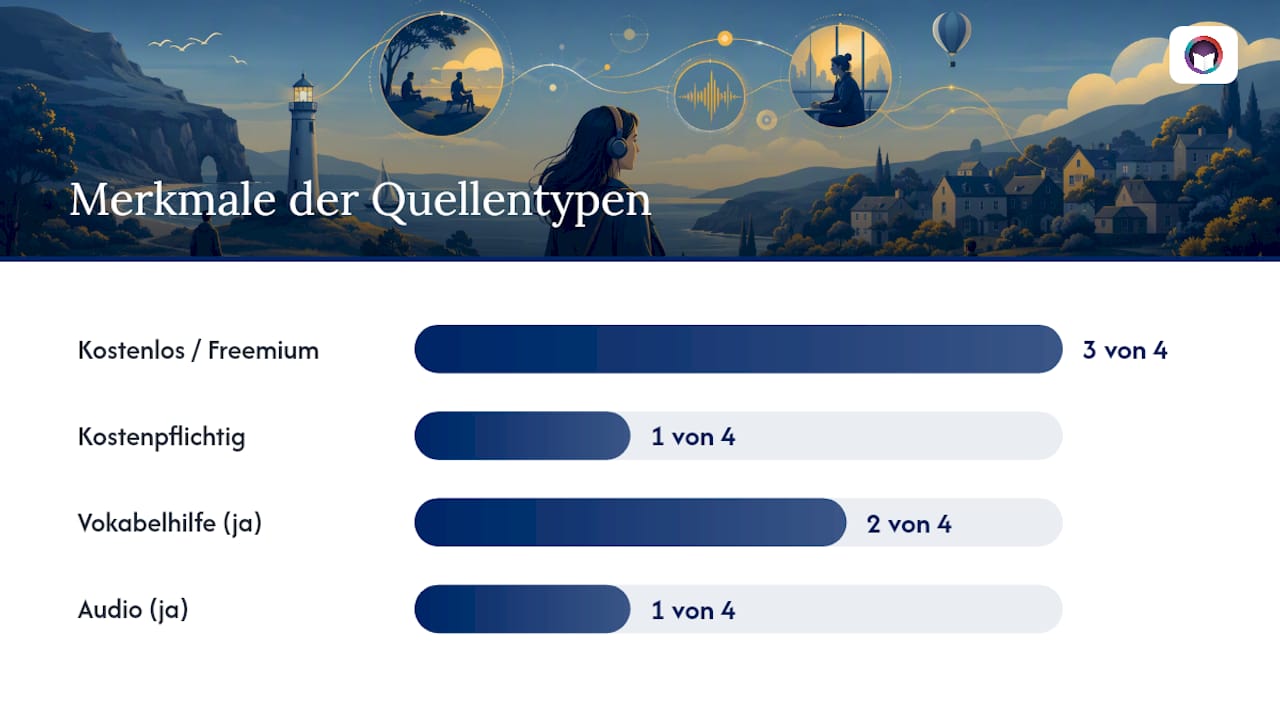
The sources can be roughly divided into four types. Each type has its place in a learner’s routine.
Public-domain collections are the easiest entry. Platforms like Americanliterature list hundreds of classics from Poe to Hemingway, free and without registration. Project Gutenberg offers complete volumes for download. The downside: no vocabulary help, no audio.
Learning platforms with vocabulary support fill this gap. Vokabel.org provides English texts with German translations, EnglishClub offers graded short stories with vocabulary aids from B2 to C1. Cornelsen publishes publisher collections with WordChecker functions and didactic exercises, which are particularly suitable for classroom use.
Audio platforms and podcasts complement the reading experience. Clarkesworld Magazine, for example, publishes professional audio readings of science-fiction short stories with transcripts. Outastory combines text and audio version directly on one platform.
| Quellentyp | Kosten | Vokabelhilfe | Audio | Beispiel |
|---|---|---|---|---|
| Public Domain | free | no | rare | AmericanLiterature, Project Gutenberg |
| Lernplattform | free/freemium | yes | partly | Vokabel.org, EnglishClub |
| Verlagssammlung | paid | yes | rare | Cornelsen |
| Story-Plattform | free/freemium | no | yes | Outastory |
Which short stories suit your level? Titles by CEFR
Cornelsen emphasizes that short stories promote reading competence, idiomatic expressions and analytical text comprehension. Choosing titles by CEFR level makes the difference between frustration and real progress.
A1–A2: Simple language, clear plot
Here, specially written learner texts from EnglishClub or EasyEnglish are better suited than classics. If you still want to start with originals, opt for very short fables or children’s stories from the public domain.
B1–B2: Classics become accessible
- O. Henry — “The Gift of the Magi”: Clear narrative structure, emotional ending, manageable ~2,000 words. Perfect for B1.
- Kate Chopin — “The Story of an Hour”: Only about 1,100 words, but dense symbolism. Good for B2, as idiomatic expressions and implicit meanings are practiced.
- Edgar Allan Poe — “The Black Cat”: Atmospheric language, first-person narrator, approx. 3,500 words. Challenges B2 learners without overwhelming them.
C1: Stylistic complexity
- Ambrose Bierce — “An Occurrence at Owl Creek Bridge”: Non-linear narrative structure, unreliable narrator, linguistically demanding. Ideal for C1, because time levels and perspective shifts must be actively analyzed.
Pro tip: Read a story through regularly before starting several. Depth beats breadth when learning vocabulary.
How to use short stories effectively to learn English
Short, repeated, active units bring the greatest learning success. Passive reading alone is not enough.
- First read: overall understanding — Read the story once through without stopping. Understand the general content, not every word.
- Mark target words — On the second read: mark unknown words in context. Don’t look up everything, first try to infer from context.
- Listen to the audio and read along — Play the audio version and read along at the same time. This stabilizes pronunciation and speech rhythm.
- Shadowing — Repeat sentences immediately after the speaker. Even 5 minutes per session shows effect.
- Write a short note — Summarize the story in 50 words in English. This forces active language production.
- Mini task — Write an alternative ending or change the narrative perspective. Cornelsen recommends such creative tasks as didactically particularly effective.
Session length: 20–30 minutes, three to four times per week. That is realistic and sustainable.
Pro tip: Keep a personal word journal: write new vocabulary with the sentence in which you found it. Context is better than isolated word lists.
Why audio helps when learning and where to find it
Combined reading and listening improves pronunciation, speech rhythm and comprehension faster than reading alone. This is especially true when text and audio are available simultaneously.

Clarkesworld Magazine publishes professional audio readings with transcripts. The format is ideal: you read along, hear the intonation, and can repeat individual passages. Outastory offers an audio version for each story, spoken by professional narrators or the author themself.
Practical sources for English audio stories:
- Outastory: text and audio on one platform, free to use
- Clarkesworld Podcast: science-fiction short stories with transcript, new episodes monthly
- LibriVox: public-domain audiobooks, free, community narrators
- YouTube: many classics read aloud, sometimes with subtitles
When listening, reading along significantly increases the effect. Those who only listen without seeing the text quickly lose track with unfamiliar words.
How to tell if a text really matches your level
Check the CEFR label, vocabulary density, sentence length and number of characters before choosing a story.
Checklist for text selection:
- Is a CEFR level indicated?
- Is there a glossary or annotations directly in the text?
- Is a parallel translation or summary available?
- Is an audio version or a transcript available?
- Does the text span 1,000–7,000 words for a session?
- Does the story have few main characters and a clear plot?
Reedsy describes that texts with a limited number of characters, short exposition and goal-oriented plot significantly reduce cognitive load for beginners. This is no coincidence: fewer characters mean less pronoun confusion and fewer context switches.
WordChecker functions, like those offered in Cornelsen collections, allow unknown words to be looked up directly in the text. This is more efficient than a separate dictionary because it does not interrupt the reading flow.
What Outastory offers learners
Outastory is especially suitable for learners who want to combine text and audio without detours. The platform is free to use and offers stories in German and English.
What the platform specifically offers:
- Free short stories and audio versions, playable directly in the browser
- Professional narrators and author voices for each story
- Genres from fantasy and crime to horror and romantasy
- Children’s section with bedtime stories and animal adventures
- Serial chapter stories for continuous learning
- Premium upgrade for offline use and unlimited listening
For learners the serial format is particularly valuable: reading and listening to a continuing story chapter by chapter builds vocabulary and context across multiple sessions, instead of starting from scratch each time.
Pro tip: Use Outastory for English genres that truly interest you. Motivation is the strongest learning factor. If you love fantasy, you’ll learn faster with fantasy stories than with neutral practice texts.
Which authors suit which learning level?
The choice of author is as important as the choice of title. Style, sentence structure and vocabulary vary considerably.
O. Henry writes clear, dialogue-rich prose with surprising endings. His vocabulary is accessible for B1 learners, and the stories are short enough for one session. “The Gift of the Magi” and “The Last Leaf” are classic starters.
Kate Chopin works with implicit meaning and emotional density. Her texts are not linguistically difficult but require willingness to interpret. B2 level is realistic.
Edgar Allan Poe is atmospheric and verbose. His vocabulary is demanding, sentence structures complex. Suitable for B2 with vocabulary help, for C1 without. Literary Hub regularly lists Poe among the most iconic English-language short story authors.
Ambrose Bierce writes precisely but with structural experiments. “An Occurrence at Owl Creek Bridge” is a C1 text that actively challenges time levels and narrative perspective.
Ernest Hemingway stands for the “iceberg style”: short sentences, few adjectives, lots of subtext. Technically accessible for B2, interpretatively demanding for C1.
Integrate short stories firmly into daily routine
Fixed reading times work better than spontaneous reading phases. Those who embed short stories into an existing routine read more regularly.
Concrete approaches:
Morning routine: 15 minutes of reading right after getting up, before the day begins. Short texts fit well into this time slot.
Lunch break: Listen to an audio version while you eat. No screen needed, no effort.
Evening: Shadow and write a summary. That cements the learning before sleep.
For note-taking techniques: write new words not in lists but in full sentences from the text. Someone who notes “melancholy” in the sentence “The room had a melancholy air” remembers it better than someone who only writes “melancholy = Schwermut”. Digital flashcards with Anki or similar tools help with spaced repetition over several days.
Useful collections and links
All sources mentioned in the article at a glance:
- Vokabel: bilingual texts, free
- EnglishClub — Short Stories (B2–C1): graded collection with vocabulary aids
- AmericanLiterature — 100 Great Short Stories: public-domain classics, free
- Cornelsen — English short stories: publisher collections with didactic tasks
- Clarkesworld Magazine — Audio: professional audio readings with transcript
- Literary Hub — Iconic short stories: curated list of classics
- Outastory: read and listen for free, German and English
Note: Public-domain texts are free to use when copyright has expired. In Germany the protection period is 70 years after the author’s death. All classics mentioned above (Chopin, Poe, O. Henry, Bierce, Hemingway) are in the public domain.
Read and listen to English short stories directly on Outastory
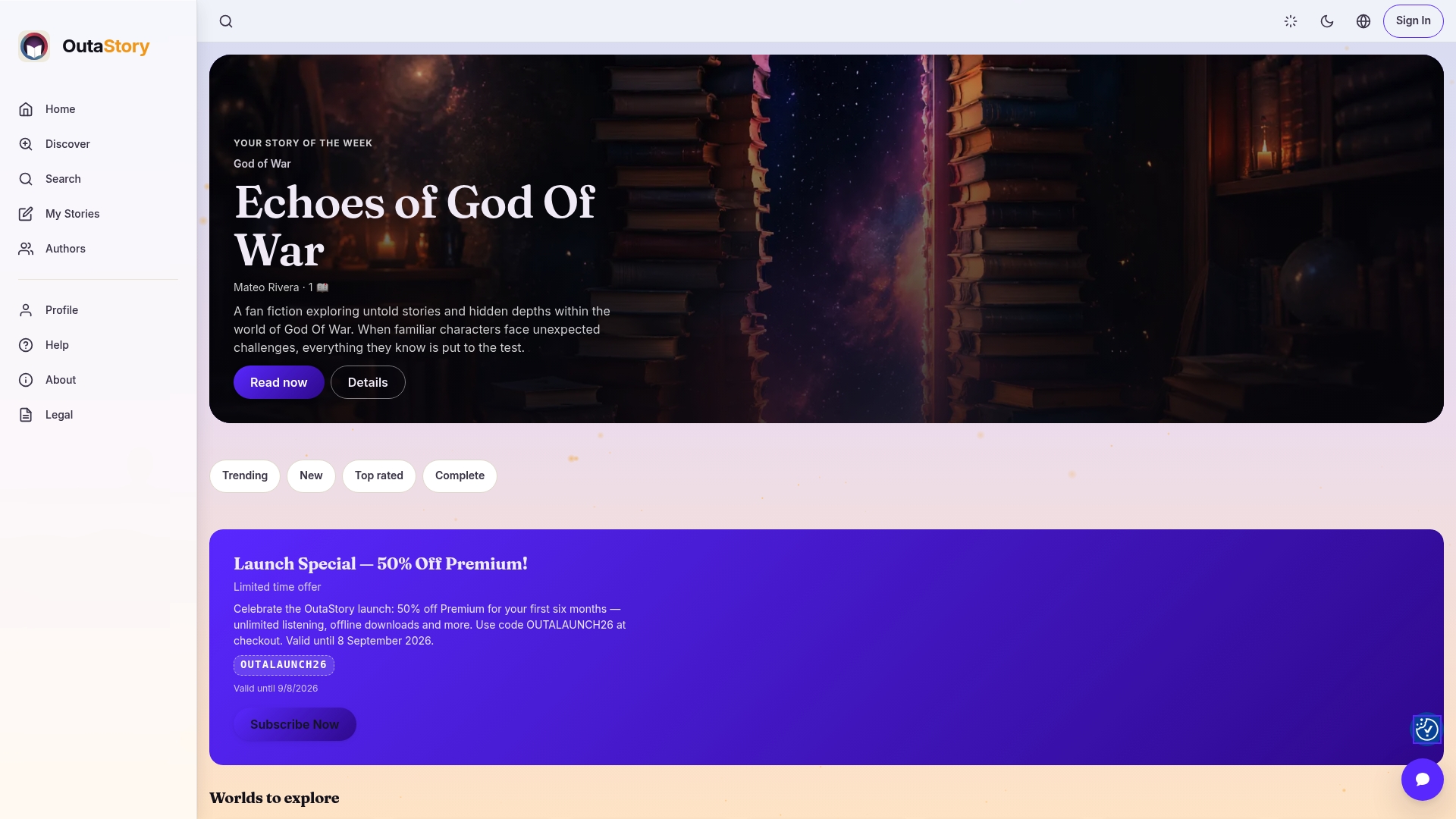
Anyone who wants to read and listen to English short stories at the same time will find both on Outastory in one place. No separate app for audio, no switching between platforms. You open a story, read the text and play the audio version directly. Professional narrators or the author’s own voice. Genres from crime to fantasy to horror, plus a dedicated children’s area. Getting started is free. If you want more — offline access and unlimited listening — you can upgrade to Premium. For learners who want to consistently combine text and audio, it’s an honest, straightforward start. Browse Outastory for free now and read or listen to your first story today.
Key takeaways
CEFR-graded English short stories with vocabulary help and audio are the most effective entry point for German-speaking learners because they combine focused reading, active vocabulary work and listening practice in one session.
Sources
- English short stories & Short Stories | Cornelsen
- English short stories texts in German and English | Learn English
- Reedsy — Short Stories
- Short Stories in English (B2‑C1) | EnglishClub
- Clarkesworld Magazine — Audio Short Story (The Life And Times Of The Extraterrestrial Potoo)
FAQ
Which English short stories are suitable for beginners?
For A2–B1, graded texts from EnglishClub or Vokabel.org are better suited than original texts. If you want to start with classics, reach for O. Henry’s “The Gift of the Magi”: clear structure, around 2,000 words, emotionally accessible.
Where can I find free English short stories online?
AmericanLiterature.com lists hundreds of public-domain classics for free. Vokabel.org offers bilingual texts in German and English. Outastory provides stories for free to read and listen to.
Which well-known English short stories exist?
Among the best known are Edgar Allan Poe’s “The Black Cat”, Kate Chopin’s “The Story of an Hour”, O. Henry’s “The Gift of the Magi” and Ambrose Bierce’s “An Occurrence at Owl Creek Bridge”. All are in the public domain and available online.
Are there English short stories with audio?
Yes. Outastory offers audio versions right next to the text. Clarkesworld Magazine publishes professional audio readings monthly with transcripts. LibriVox provides public-domain audiobooks for free.
How many short stories should I read per week?
One story per week, read completely and worked on actively, brings more than several superficially read texts. Three to four study sessions of 20–30 minutes per week are realistic and sustainable.
Read and write on OutaStory
Thousands of short stories to read for free — or publish your own and find an audience.